
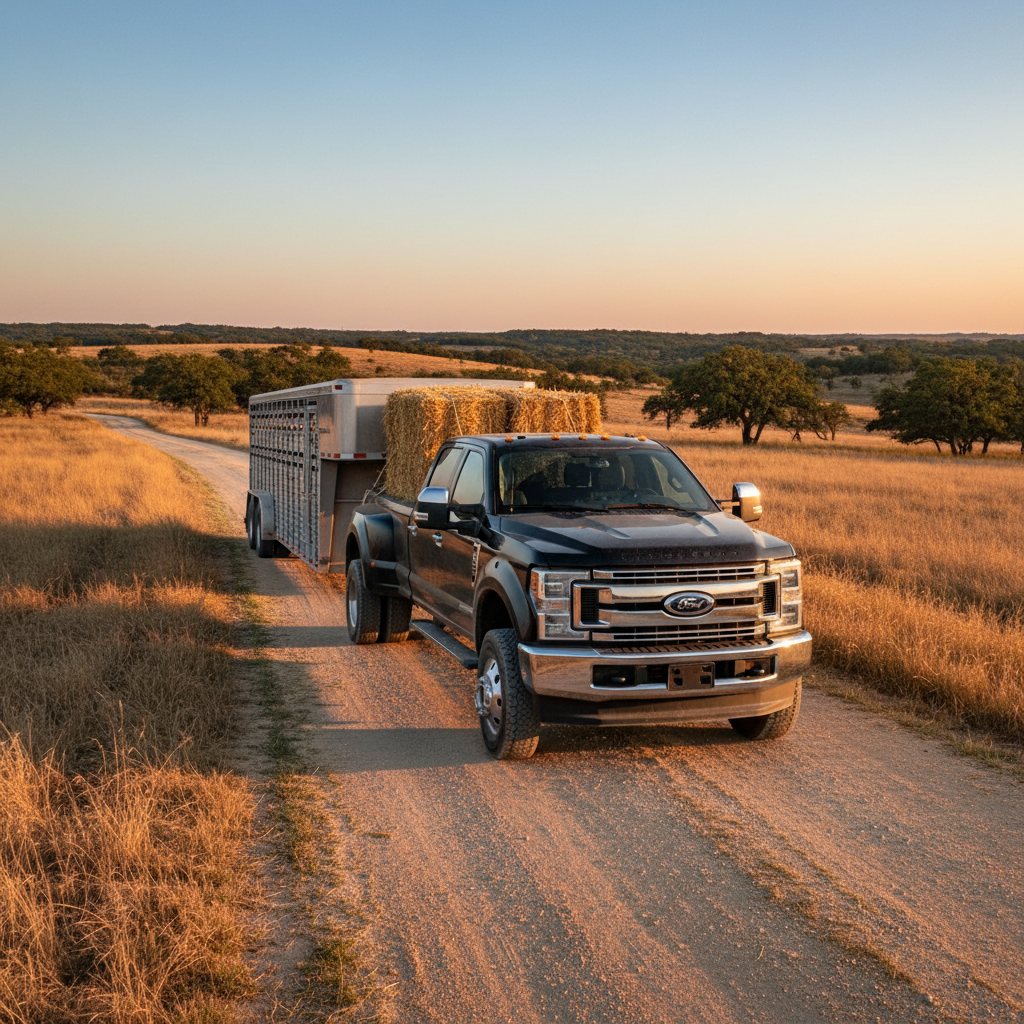
As the General Sales Manager here at Cecil Atkission Ford with over 10 years of experience, I’ve worked closely with ranchers and farmers around Medina County who face the challenge of choosing the right truck for their specific hauling needs. Whether you’re moving livestock from pasture to pen near Lakehills or hauling large amounts of hay bales across your property in Pipe Creek, the right specs for your Ford Super Duty can make a big difference in efficiency, safety, and long-term durability.
The key to choosing the right Super Duty starts with understanding the distinct demands of hauling livestock versus hauling hay. Livestock trailers require attentive hauling characteristics because animals inside need a smoother, steadier ride to reduce stress and injury. That means a truck with stable handling and the right suspension setup becomes critical. On the other hand, hay hauling generally involves heavy, bulky loads that require maximum payload capacity and often benefit from longer bed lengths for easier loading and stacking.
In my experience, Medina County ranchers hauling livestock often gravitate toward Super Duty models with a focus on balance—enough towing power to pull heavy gooseneck trailers without sacrificing ride quality. Choosing a configuration with a strong suspension system and perhaps a dual rear wheel setup provides the necessary stability on uneven terrain common around Dunlay and Uvalde. The Super Duty’s available advanced towing features, including trailer sway control and integrated brake controllers, are also real game-changers for safely managing livestock trailers.
For those hauling hay, the conversation shifts slightly. Here, payload capacity and bed size take center stage. Hay bales can easily pile up in volume, so selecting a Super Duty with the right bed length—typically an 8-foot bed—makes loading and unloading more efficient. Additionally, maximizing payload specs ensures your truck can handle the weight without excessive wear or compromised fuel efficiency. A single rear wheel configuration may be sufficient here, especially if the terrain is relatively flat and the hauling distances are moderate.
The choice of engine also plays a role in matching specs to hauling needs. While the 6.7L High Output Power Stroke diesel offers impressive torque and towing capabilities suited for heavy livestock trailers, the 7.3L Godzilla gas engine provides solid power and often a smoother driving experience for hay transport. We’ll get into those details shortly.
Ultimately, the best way to find a Ford Super Duty that fits your Medina County ranch’s unique hauling requirements is to work with a team that understands local needs. Our staff here at Cecil Atkission Ford take pride in helping customers from Lytle to Lakehills find trucks that stand up to the demands of ranch life while providing comfort and confidence on every trip. If you want to explore our latest lineup of New Ford Heavy Duty Trucks or learn more about Ford Owner Benefits that can support your investment, we’re ready to assist. Feel free to call us at (830) 426-5391 or get directions to Cecil Atkission Ford for a hands-on discussion tailored to your ranch’s needs.
This decision isn’t just about specs on paper— it’s about matching those specs to the real-world demands you face every day on your ranch.
Table of Contents
- Understanding the 2026 Ford Super Duty Towing Capacities Across Engine Options
- Single vs. Dual Rear Wheel Configurations: What Works Best for Medina County Ranching?
- Comparing the 6.7L High Output Power Stroke Diesel and the 7.3L Godzilla Gas Engine for Heavy Hauling
- Maximizing Payload and Bed Length: How to Haul Hay Efficiently with the 2026 Super Duty
Understanding the 2026 Ford Super Duty Towing Capacities Across Engine Options
When it comes to heavy-duty hauling around Medina County, knowing the towing limits of the 2026 Ford Super Duty based on its engine choices is crucial. Each powertrain offers distinct capabilities, making it essential to align your truck’s setup with your specific ranching demands.
The 2026 Super Duty lineup features three main engine options, each built to deliver power and reliability in different ways. Starting with the 7.3-liter Godzilla V8 gasoline engine, this option provides solid torque and horsepower, making it a versatile choice for ranchers handling moderate towing tasks, like small livestock trailers or lighter hay loads. It offers a balanced combination of performance and durability, suitable for those around rural areas like Lytle or Dunlay who prioritize everyday dependability.
For those needing more muscle, the 6.7-liter High Output Power Stroke diesel stands out. This engine is engineered specifically for heavy towing and demanding workloads typical in tough Texas ranching conditions. It generates significantly higher torque, which enhances its ability to pull larger livestock trailers or fully loaded hay haulers without strain. This is particularly relevant for ranchers in areas like Uvalde, where larger loads and steep terrain often come into play.
The standard 6.8-liter gas engine also remains a noteworthy option for those whose towing requirements fall between the Godzilla V8 and diesel variant. While it doesn’t match the diesel’s torque, it still delivers strong towing capacity and a reliable workhorse feel.
Understanding these towing differences helps when selecting the right Super Duty to meet your ranch’s hauling needs. It’s more than just numbers— it’s about how those numbers translate into confidence and capability on your Medina County ranch. If you’re considering used trucks with specific engine setups, browsing our All Pre-Owned Inventory might reveal the perfect fit for your hauling requirements. Learn more about our dedication to the community through our Community Commitment and discover the story behind our service at Our Story.
Single vs. Dual Rear Wheel Configurations: What Works Best for Medina County Ranching?
When it comes to selecting between single rear wheel (SRW) and dual rear wheel (DRW) setups on a 2026 Ford Super Duty, the choice hinges largely on the kind of ranch work you’re tackling around Medina County. Each configuration brings distinct advantages depending on whether you’re hauling livestock or moving large loads of hay.
Single rear wheel trucks offer greater maneuverability, especially useful on narrow ranch roads or tighter spaces near barns and pens in areas like Lytle. They also tend to have a smoother ride on highways and lighter loads, making them a solid choice for smaller trailers and less frequent heavy hauling. If your ranching primarily involves hauling livestock trailers that are moderate in size and weight, an SRW might balance capability with everyday drivability.
On the other hand, dual rear wheel trucks bring enhanced stability and a higher payload capacity, crucial when you’re hauling heavy gooseneck trailers loaded with hay or multiple animals, especially around rugged terrain common near Lakehills or Dunlay. The extra tires distribute weight more evenly, reducing strain on the suspension and improving traction. This is especially beneficial for Medina County ranchers who regularly transport large livestock groups or bulky hay loads over uneven ground.
From personal experience at Cecil Atkission Ford, many customers servicing ranches in locations like Uvalde find DRW setups invaluable for their heavy-duty needs, while others lean on SRW models for their versatility and price point. If you’re weighing your options, consider how often you’ll max out payloads or tow near your truck’s limit. With either choice, our team can help you explore financing options through a finance application, explain the benefits of the Cecil Advantage that supports Medina County ranchers like you, or use our payment estimator tool to estimate your monthly costs.
Understanding these nuances ensures you get the right truck tailored to your specific ranching demands.
Comparing the 6.7L High Output Power Stroke Diesel and the 7.3L Godzilla Gas Engine for Heavy Hauling
From my experience as General Sales Manager at Cecil Atkission Ford with over 10 years in the business, selecting between the 6.7L High Output Power Stroke diesel and the 7.3L Godzilla gas engine boils down to your specific hauling needs and operational priorities on your Medina County ranch.
The 6.7L Power Stroke diesel is built for serious torque and endurance, delivering robust low-end power that’s ideal for heavy-duty towing—especially when hauling fully loaded livestock trailers over uneven terrain around places like Lakehills or Pipe Creek. Its turbocharged design provides smoother, sustained pulling power, which helps with fuel efficiency on longer hauls. Plus, diesel engines tend to have longer service intervals and higher resale value, though they require diligent maintenance to handle dusty ranch conditions.
On the other hand, the 7.3L Godzilla gas engine brings strong horsepower and quick throttle response, making it well-suited for lighter to mid-weight loads or shorter trips where frequent stops and starts are common, like moving hay bales around a pasture near Dunlay. Gas engines generally require less expensive repairs and parts, and their simpler design means they can be easier to maintain for those who want straightforward upkeep.
Choosing between these engines also involves balancing upfront costs and long-term operating expenses. For ranchers focused on maximum towing muscle with fuel economy over long distances, the diesel often wins out. But for those whose work emphasizes flexibility and lower maintenance costs, the 7.3L gas engine provides dependable power without some of the diesel-specific complexities.
If you want to explore specifics or maintenance tips, our expert team is ready to help, and you can also check out our parts department for genuine Ford components that keep your truck running strong. For financing options tailored to your needs, visit our Finance Center. To learn more about our knowledgeable team, visit Our Expert Staff.
Maximizing Payload and Bed Length: How to Haul Hay Efficiently with the 2026 Super Duty
When it comes to hauling hay around ranches near Lakehills or Dunlay, the bed length and payload capacity of your truck make a big difference. The 2026 Ford Super Duty offers several bed length options, including a standard 6.75-foot bed and an extended 8-foot bed, giving you flexibility depending on how much hay you need to move at once.
Payload capacity is crucial too—especially if you’re stacking large bales. The Super Duty’s payload can reach over 7,000 pounds when properly equipped, which means less back-and-forth trips hauling hay. This is especially useful when working out in areas like Pipe Creek, where efficiency matters.
A longer bed combined with a high payload lets you carry more hay securely without overloading your truck. Whether you’re loading small square bales or large round ones, the right Super Duty configuration can handle the job. If you’re considering a truck specifically built for these tasks, feel free to get directions to Cecil Atkission Ford and see our lineup firsthand. You can also call us at (830) 426-5391 and speak with one of our experts about the best fit for your ranch needs.
Connect with us


Recent Blog Entries
- Drive Confident: Ford’s Blue Advantage Program Puts Texas Drivers at Ease
- Discover the Texan Truck Experience Everyone’s Driving Hours to Get
- Conquer Any Road Instantly: How the 2026 Bronco’s Tech Transforms Off-Road Driving
- Drive Home Smarter: How Ford Credit Powers Easy, Tailored Auto Financing in Hondo
- Choosing the Right 2026 Ford Maverick Powertrain for Texas Commuters