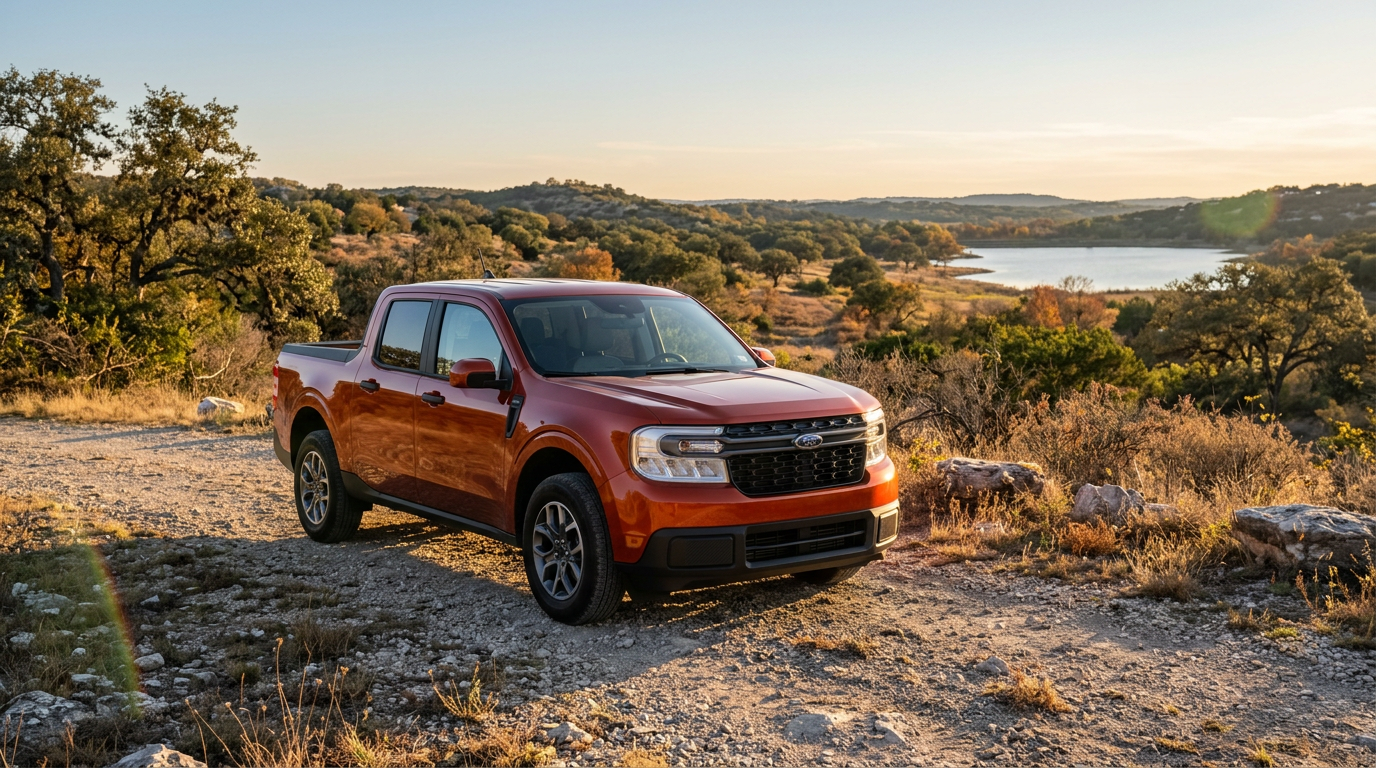

Choosing between the 2.5L Hybrid and the 2.0L EcoBoost on the 2026 Ford Maverick comes down to your primary driving demands. Drivers seeking maximum fuel economy should select the 2.5L Hybrid with its power-split electronic continuously variable transmission (eCVT), delivering up to an EPA-estimated 42 mpg city. Buyers needing maximum towing capacity, high-speed passing power, or specialized off-road hardware should choose the 2.0L EcoBoost, which produces 250 hp and 280 lb-ft of torque paired with an 8-speed automatic transmission or a performance 7-speed automatic transmission on the Lobo trim. The 2026 Ford Maverick lineup redefines what compact pickups can accomplish, bringing distinct transmission architectures engineered for two entirely different driver profiles. The standard 2.5L Hybrid powertrain utilizes a power-split eCVT that combines a 2.5-liter Atkinson-cycle four-cylinder engine with electric motor-generators. This system produces a net 191 hp and 173 lb-ft of torque, focusing on smooth urban acceleration and class-leading city efficiency. For drivers carrying gear out toward Medina Lake or traversing the Hill Country terrain near Lakehills, choosing between the hybrid and turbo powertrains depends on whether your priority is max fuel efficiency or maximum towing capacity. For those requiring heavier capability, the optional 2.0L EcoBoost turbocharged four-cylinder engine elevates output to 250 hp and 280 lb-ft of torque. Standard EcoBoost models transmit power through a robust 8-speed automatic transmission that features torque-converter lockup for direct gear engagement under heavy acceleration. When equipped with the optional 4K Tow Package, the EcoBoost doubles the Maverick's standard 2,000-lb towing capacity to a maximum rating of 4,000 lbs, making it the clear choice for pulling campers, utility trailers, or watercraft. Experience both driving dynamics in person at Cecil Atkission Ford by finding our Hondo dealership showroom or giving our team a quick phone call to speak with our truck specialists. Table of Contents How Do the Maverick Hybrid eCVT and EcoBoost Transmissions Differ by Configuration? What Transmission Is in the 2026 Ford Maverick EcoBoost and Is All-Wheel Drive Standard? How Does the Ford Maverick Hybrid eCVT Work and Does It Have Belts or Chains? How Does City vs Highway Driving Impact Maverick Hybrid eCVT Efficiency? When Should Transmission Fluid Be Changed in a Ford Maverick EcoBoost? Frequently Asked Questions About 2026 Ford Maverick Transmissions Test-Drive the 2026 Ford Maverick Powertrains How Do the Maverick Hybrid eCVT and EcoBoost Transmissions Differ by Configuration? The 2026 Ford Maverick transmission options vary directly by trim level, engine choice, and drivetrain layout across the model lineup. The 2.5L Hybrid pairs exclusively with an electronic continuously variable transmission (eCVT) in both front-wheel drive and all-wheel drive configurations. The 2.0L EcoBoost pairs with an 8-speed automatic transmission on standard and Tremor trims, while the street-tuned Maverick Lobo uses a quick-shifting 7-speed automatic transmission equipped with steering-wheel-mounted paddle shifters. Ford structures the Maverick line to give truck buyers flexible mechanical pairings across five distinct trim levels: XL, XLT, Lariat, Lobo, and Tremor. On the XL, XLT, and Lariat trims, the standard 2.5L Hybrid delivers 191 hp and 173 lb-ft of torque through the eCVT. Front-wheel drive comes standard on the XL and XLT hybrid configurations, while all-wheel drive is available as an option across XL, XLT, and standard on the Lariat AWD hybrid. Selecting the 2.0L EcoBoost engine changes the transmission hardware completely. On standard XL, XLT, and off-road-focused Tremor 4WD models, the engine drives through an 8-speed automatic transmission engineered for high torque capacity and smooth shift intervals. The Tremor 4WD model adds a twin-clutch rear-drive unit with a differential lock feature for technical off-road traction. The performance-minded Maverick Lobo introduces a unique drivetrain build. Available in Lobo Standard 4WD and Lobo Premium 4WD trims, it pairs the 250 hp 2.0L EcoBoost with a specialized 7-speed automatic transmission adapted from European performance models. This quick-shift gearbox includes manual paddle-shifter control and a specialized torque-vectoring rear drive unit. Explore our new Ford Maverick lineup to find the precise trim configuration that matches your driving requirements. Engine & Performance Powertrain specs by trim Feature Lariat AWD Lobo Premium 4WD Lobo Standard 4WD Tremor 4WD XL AWD XL FWD Engine 2.5L 2L 2L 2L 2.5L 2.5L Horsepower 191 hp 250 hp 250 hp 250 hp 191 hp 191 hp Torque 173 lb-ft 277 lb-ft 277 lb-ft 277 lb-ft 173 lb-ft 173 lb-ft Transmission CVT automatic 7-speed automatic 7-speed automatic 8-speed CVT CVT Drivetrain All-wheel drive Four-wheel drive Four-wheel drive Four-wheel drive All-wheel drive Front-wheel drive Engine & Performance (continued) Feature XLT AWD XLT FWD Engine 2.5L 2.5L Horsepower 191 hp 191 hp Torque 173 lb-ft 173 lb-ft Transmission CVT CVT Drivetrain All-wheel drive Front-wheel drive What Transmission Is in the 2026 Ford Maverick EcoBoost and Is All-Wheel Drive Standard? The 2026 Ford Maverick EcoBoost utilizes a torque-converter 8-speed automatic transmission on standard models and a 7-speed automatic transmission on the Lobo performance trim. All-wheel drive is not standard on base EcoBoost configurations; front-wheel drive comes standard on entry-level EcoBoost models, while intelligent all-wheel drive is an available upgrade or standard equipment on higher-tier and performance trims. The core transmission powering the 2.0L EcoBoost engine is Ford's 8F35 8-speed automatic transmission. Designed specifically for transverse front-wheel-drive and all-wheel-drive applications, the 8-speed automatic uses planetary gearsets and hydraulic clutch packs to maintain optimal engine RPM across varying road speeds. A wide overall gear ratio spread ensures strong off-the-line launch torque in first gear while dropping highway engine speeds in eighth gear to optimize fuel economy. Drivetrain availability on the EcoBoost varies depending on the selected package and trim tier. While early model years linked the EcoBoost exclusively to all-wheel drive, the 2026 lineup allows buyers to pair the EcoBoost engine with front-wheel drive on select models for reduced weight and lower initial acquisition cost. Intelligent all-wheel drive remains available across the board, utilizing electro-hydraulic coupling to route torque to the rear wheels whenever front-wheel slip is detected. On specialized trims, all-wheel drive comes standard from the factory. The Tremor 4WD incorporates an advanced torque-on-demand four-wheel-drive system with a rear-drive unit capable of lockup for mud, sand, and loose gravel. The Maverick Lobo features a performance tuned four-wheel-drive setup paired with its 7-speed automatic transmission, delivering high-G cornering traction on pavement. Shoppers comparing new trucks against pre-owned options can inspect our pre-owned vehicle inventory to evaluate how previous-generation EcoBoost drivetrains compare on the road. How Does the Ford Maverick Hybrid eCVT Work and Does It Have Belts or Chains? The 2026 Ford Maverick Hybrid electronic continuously variable transmission (eCVT) operates using a durable power-split planetary gearset and two electric motor-generators without any friction belts, steel bands, or variable pulleys. Power from the 2.5L engine and the electric traction motor blends mechanically through the planetary gears, continuously adjusting gear ratios electronically to match speed and load demands seamlessly. Unlike conventional mechanical CVTs found in many compact passenger cars, the Maverick's eCVT contains zero push-belts or flexible drive chains that could stretch, slip, or wear out over time. Traditional CVTs rely on hydraulic pressure pushing steel belts between conical pulleys, creating friction points that require frequent maintenance and limit torque handling. Ford's power-split transaxle eliminates these friction elements entirely, replacing them with fixed mesh planetary gears that offer lifetime mechanical durability under demanding truck duties. The mechanical interaction inside the power-split eCVT relies on three main rotational components: a sun gear, planetary carrier gears, and a ring gear: The 2.5L Atkinson-cycle engine connects directly to the planetary gear carrier. Electric Motor-Generator 1 (MG1) connects to the center sun gear, acting as a generator and controlling overall ratio changes electronically. Electric Motor-Generator 2 (MG2) connects to the outer ring gear, providing electric drive torque directly to the differential and driving the wheels. Because MG1 can vary its rotational speed and direction electronically, it continuously alters the leverage applied to the planetary gearset. This allows the system to vary drive ratios seamlessly from a complete stop up to highway cruising speeds without physical gear shifts. Buyers evaluating financing choices for a new hybrid truck can start by applying for online credit pre-approval before visiting the dealership floor. How Does City vs Highway Driving Impact Maverick Hybrid eCVT Efficiency? City driving maximizes the efficiency of the 2026 Ford Maverick Hybrid eCVT, yielding an EPA-estimated 42 mpg city on front-wheel-drive models and 40 mpg city on all-wheel-drive models. In contrast, highway driving relies more heavily on the continuous output of the internal combustion engine, resulting in 35 mpg highway on front-wheel-drive hybrid models and 34 mpg highway on all-wheel-drive hybrid models. Stop-and-go urban driving environment provides the ideal operational environment for the hybrid transaxle. During low-speed city travel, frequent braking events allow the secondary electric motor (MG2) to act as a generator, capturing kinetic energy and storing it inside the 1.1-kWh lithium-ion battery. When accelerating from red lights or creeping through traffic, the power-split eCVT can drive the vehicle solely on electric power or blend battery power with minimal engine engagement, driving fuel consumption down significantly. On open highways, the efficiency dynamic shifts toward the internal combustion engine. At sustained high speeds, electric propulsion plays a smaller role because kinetic regeneration opportunities are infrequent, and continuous high-speed movement requires constant torque output from the 2.5L gas engine. Even on the highway, however, the eCVT maintains efficiency by continuously fine-tuning the planetary gear ratio to keep the engine operating in its sweet spot. By comparison, the 2.0L EcoBoost engine achieves higher relative efficiency during highway cruising than in heavy city stop-and-go traffic: XL FWD / XLT FWD Hybrid: 42 mpg city / 35 mpg highway / 38 mpg combined XL AWD / XLT AWD Hybrid: 40 mpg city / 34 mpg highway / 37 mpg combined Lariat AWD Hybrid: 39 mpg city / 32 mpg highway / 36 mpg combined Lobo Standard / Premium 4WD EcoBoost: 21 mpg city / 30 mpg highway / 24 mpg combined Tremor 4WD EcoBoost: 21 mpg city / 27 mpg highway / 23 mpg combined Maintaining peak powertrain efficiency over the life of your truck requires proper air filtration and fluid quality; local owners can maintain their vehicles by ordering genuine OEM Ford parts directly through our service counter. Fuel Economy Fuel economy and range by trim Trim MPG Lariat AWD 39 city / 32 hwy / 36 combined Lobo Premium 4WD 21 city / 30 hwy / 24 combined Lobo Standard 4WD 21 city / 30 hwy / 24 combined Tremor 4WD 21 city / 27 hwy / 23 combined XL AWD 40 city / 34 hwy / 37 combined XL FWD 42 city / 35 hwy / 38 combined XLT AWD 40 city / 34 hwy / 37 combined XLT FWD 42 city / 35 hwy / 38 combined When Should Transmission Fluid Be Changed in a Ford Maverick EcoBoost? The 2026 Ford Maverick EcoBoost's transmission fluid requires attention at specific intervals: inspection at 30,000 miles and replacement at 150,000 miles with Mercon ULV fluid. However, under severe operating conditions—such as frequent towing near the 4,000-lb max towing capacity, hauling heavy loads, off-roading, or driving in high ambient summer temperatures—Ford technicians recommend changing the transmission fluid every 30,000 to 60,000 miles. The 8F35 8-speed automatic transmission in the Maverick EcoBoost operates under intense mechanical shear forces and thermal stress. The unit utilizes ultra-low viscosity Mercon ULV fluid, which provides low fluid resistance to optimize fuel economy. Over time, heat cycles generated during heavy acceleration or trailering can break down the fluid's protective additive package, reducing its ability to lubricate internal clutch packs and planetary gear bearings effectively. Hauling tools and agricultural supplies across the dirt roads around Dunlay qualifies as severe duty, making early fluid service essential for long-term transaxle reliability. Driving patterns that warrant moving up to the severe maintenance schedule include: Regularly pulling trailers or carrying maximum payload capacity in the bed. Extensive idling or frequent stop-and-go driving in high outdoor temperatures. Driving in dusty, unpaved rural areas or rugged off-road environments. Navigating steep, continuous mountain grades or hill country roads. Changing the Mercon ULV fluid at 30,000 to 60,000-mile intervals flushes out microscopic metal wear particles and restores thermal stability to the hydraulic control valve body. Drivers who require extreme hauling muscle beyond compact truck capabilities can explore our inventory of new Ford heavy-duty commercial trucks to handle heavy commercial workloads. Frequently Asked Questions About 2026 Ford Maverick Transmissions Q: Does the 2026 Ford Maverick Hybrid eCVT require special transmission fluid? Yes, the power-split eCVT in the 2026 Ford Maverick Hybrid requires Motorcraft Mercon ULV automatic transmission fluid, the same ultra-low viscosity fluid specification used in the EcoBoost 8-speed automatic transmission. Even though the hybrid transaxle uses planetary gearsets rather than hydraulic clutches for gear shifts, the fluid is vital for cooling the electric motor-generators and lubricating the internal gearing. Ford recommends inspecting the fluid level during regular maintenance and replacing it at 150,000 miles under normal operation or 30,000 miles under severe duty. Q: Can the 2026 Ford Maverick Hybrid tow up to 4,000 pounds with the eCVT? No, the 2026 Ford Maverick Hybrid with the eCVT has a maximum towing capacity of 2,000 lbs across all trim levels, regardless of whether you choose front-wheel drive or all-wheel drive. The 4K Tow Package, which increases maximum towing capacity to 4,000 lbs, is exclusively available on models equipped with the 2.0L EcoBoost engine and the 8-speed automatic transmission. Buyers planning to pull heavy campers, ski boats, or tandem-axle trailers should select the EcoBoost powertrain. Q: Does the 2026 Ford Maverick EcoBoost offer paddle shifters on all trims? No, steering-wheel-mounted paddle shifters are not equipped on standard EcoBoost models with the 8-speed automatic transmission. Manual gear selection via paddle shifters is exclusive to performance and off-road configurations, specifically the Maverick Lobo with its quick-shifting 7-speed automatic transmission and the Tremor model. Standard EcoBoost trims utilize Ford's rotary gear shift dial with a Low (L) mode or Tow/Haul drive mode to manage shift points under load. Q: Is all-wheel drive available on the 2026 Ford Maverick Hybrid? Yes, all-wheel drive is available on the 2026 Ford Maverick Hybrid. Ford expanded hybrid availability to include an electronic all-wheel-drive system across the XL, XLT, and Lariat trims. The hybrid AWD system pairs the 2.5L engine and eCVT with a mechanical drive shaft and rear axle differential, delivering 191 hp and enhanced foul weather traction while maintaining impressive fuel economy rated up to an EPA-estimated 40 mpg city. Q: What driving conditions qualify as severe duty for Maverick EcoBoost transmission maintenance? Ford defines severe duty operation as driving in dusty or sandy environments, frequent towing or hauling near maximum gross vehicle weight ratings, extended idling, driving in sustained hot weather, or navigating steep grades regularly. If your daily routine includes these conditions, mechanics advise shortening the 8-speed automatic transmission fluid change interval from the standard 150,000-mile mark down to every 30,000 to 60,000 miles to protect the internal clutches and transaxle bearings. Test-Drive the 2026 Ford Maverick Powertrains Experience the distinction between the smooth efficiency of the 2.5L Hybrid eCVT and the response of the 2.0L EcoBoost 8-speed automatic in person. Our team at Cecil Atkission Ford in Hondo, Texas, is ready to walk you through trim configurations, tow packages, and drivetrain options to ensure you drive home in the exact truck built for your lifestyle. Plan your visit today by getting directions to our dealership or giving our sales team a quick phone call to reserve your test drive. © 2026 Cecil Atkission Ford. All rights reserved. Vehicle specification data © JATO Dynamics Limited.