
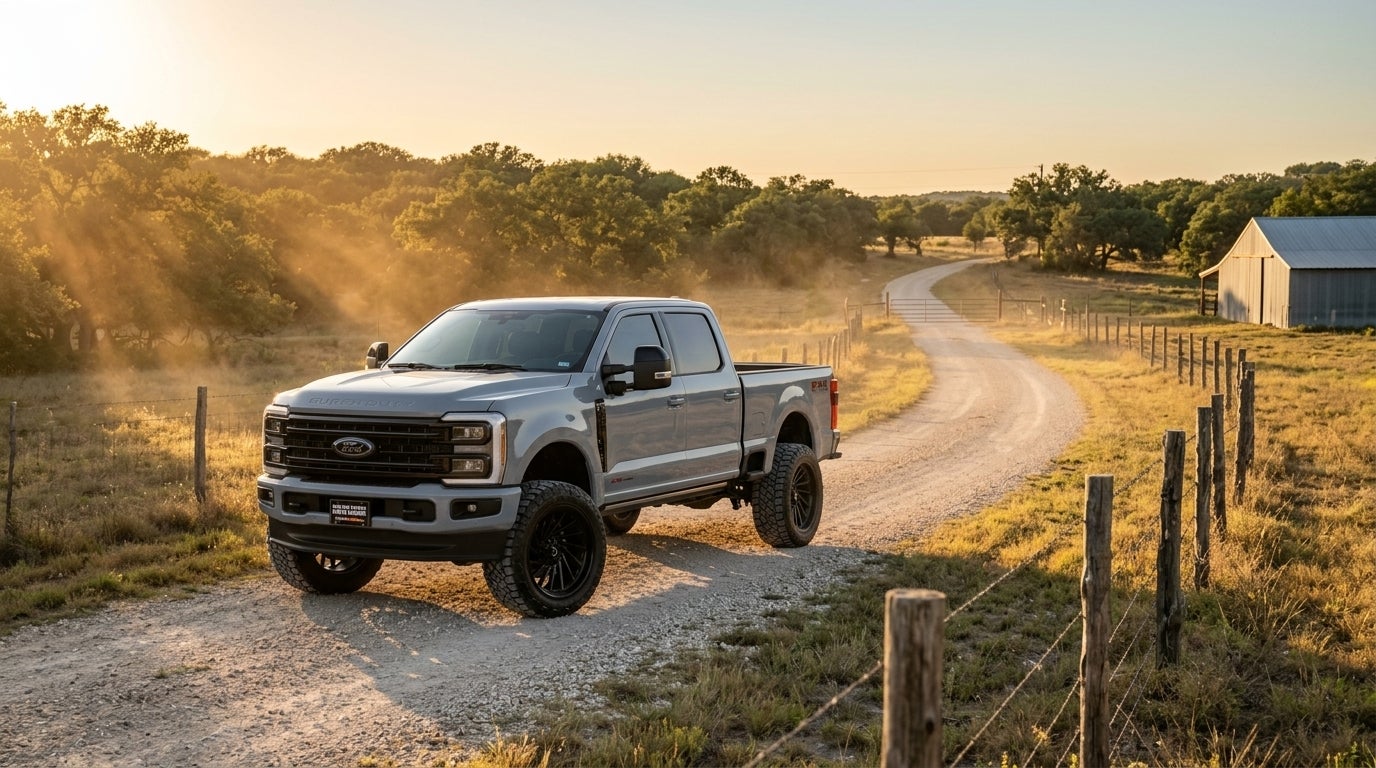
Installing a suspension lift does not automatically void the factory warranty on a 2026 Ford F-150 or F-250. Under federal warranty protection laws, Ford cannot deny coverage for unrelated components simply because a vehicle is modified. However, factory warranty claims will be denied for specific drivetrain, steering, or suspension parts if a technician determines an aftermarket lift or incorrect installation geometry directly caused the failure. Factory components like the standard 3-year/36,000-mile bumper-to-bumper warranty remain fully active for non-affected systems across all models, including new Ford F-150 models and new Ford F-250 Super Duty trucks.
When local truck owners ask us about lifting their F-150, the question we hear most often in our service bay is whether raising the suspension will void their factory powertrain coverage. The distinction lies in component causation. If a 4-inch suspension lift creates severe operating angles that destroy a constant-velocity (CV) axle boot or cause universal joint binding, Ford's factory warranty will not pay to repair those damaged driveline parts. Conversely, if an electronic module, air conditioning compressor, or power window motor fails on a lifted truck, those claims remain covered under standard factory terms because the suspension modification played no role in the mechanical failure.
To maintain peace of mind while enjoying added ground clearance, many owners opt for factory-approved upgrades or professional upfitter builds. Dealer-installed modifications and factory off-road packages utilize engineered suspension geometry that preserves factory durability standards. Owners managing their vehicle records can track routine service intervals through Ford owner benefits or monitor vehicle diagnostics directly via the FordPass app. Whether you operate a fleet of new Ford heavy duty trucks, drive versatile new Ford crew cab trucks, or explore options across new Ford SUVs and new Ford Mustang coupes, keeping detailed maintenance logs ensures valid warranty claims stay protected.
For personalized assistance, hablamos español en Cecil Atkission Ford. Drivers are welcome to visit our Hondo showroom or reach our service advisors directly at (830) 426-5391 to review warranty details before modifying a vehicle.
Table of Contents
- What Mechanical and Drivetrain Components Change When Lifting a Ford F-150 or F-250?
- Why Do Suspension Lifts Impact Engine Cooling, Aerodynamics, and Fuel Economy Under Load?
- What Are Texas Bumper Height Laws and Legal Suspension Limits for Lifted Trucks?
- What Should Owners Know About Dealer-Installed vs Aftermarket Lift Kits?
- Frequently Asked Service Questions About Lifted Ford F-150 and F-250 Trucks
- Schedule Certified Lifted Truck Maintenance
What Mechanical and Drivetrain Components Change When Lifting a Ford F-150 or F-250?
A suspension lift alters the physical alignment between a truck’s frame, differential housings, steering linkages, and drive axles. Raising the chassis changes factory suspension geometry by increasing the operational angles of front CV axle shafts on independent front suspension models and steepening the driveline angles on solid-axle Super Duty setups. Without corrective hardware, these steep angles increase friction, accelerate joint wear, and place continuous mechanical stress on wheel bearings, ball joints, steering racks, and universal joints.
On an F-150 equipped with independent front suspension, lifting the vehicle alters the working angles of the lower control arms and upper ball joints. Elevating the ride height by more than 2 inches without dropping the front differential increases the angle of the front CV boots. This continuous stretching under suspension travel leads to premature boot tearing, grease loss, and eventual joint seizure under load. On heavy-duty F-250 trucks featuring a solid front axle, a 4-inch suspension lift steepens the driveline operating angle between the transfer case and front differential. To prevent driveline vibration and high-speed binding, a complete lift installation requires radius arm drop brackets, a drop pitman arm to align steering linkage, and a carrier bearing drop kit for two-piece rear driveshafts.
Engine selection and drivetrain configuration also dictate how mechanical stress translates under the hood. The 2026 F-150 powertrain lineup ranges from the efficient 2.7L EcoBoost V6 to the naturally aspirated 5.0L V8, which generates 400 horsepower and 410 lb-ft of torque. Buyers seeking maximum output can choose the high-efficiency 3.5L PowerBoost full hybrid V6, delivering 420 horsepower and 570 lb-ft of torque, or the flagship High-Output supercharged 5.2L V8 producing 700 horsepower and 640 lb-ft of torque. When larger tires are combined with these high-torque engines, the added rotational mass transfers extra force back through the transmission clutches and differential ring gears.
Properly engineered suspension kits correct these angles using differential drop spacers, extended sway bar end links, and recalibrated steering arms. When servicing modified suspension systems, truck owners can order OEM replacement parts directly through our facility. Drivers interested in vehicle protection plans can consult our finance department, while our expert service staff remains available to evaluate driveline wear and component alignment.
Why Do Suspension Lifts Impact Engine Cooling, Aerodynamics, and Fuel Economy Under Load?
Raising a truck's ride height increases aerodynamic drag by exposing a larger surface area of the tires and underbody structure to high-speed airflow. At highway speeds, airflow that previously swept smoothly under the front bumper creates turbulent air pressure beneath the chassis, forcing the engine to work harder to maintain speed. Additionally, mounting larger, heavier tires increases overall rotational mass and unsprung weight, which demands more engine torque during acceleration and sustained hill climbs.
This added mechanical workload directly influences engine operating temperatures, especially during high ambient summer conditions in South Texas. When a lifted truck pulls a heavy trailer up steep inclines near Lakehills, the combination of elevated aerodynamic resistance and heavy tire mass forces the engine to run at higher boost pressures or elevated engine speeds. On twin-turbocharged engines like the 3.5L EcoBoost V6, continuous heavy boost increases thermal load within the intercooler and engine cooling circuit. Without adequate airflow through the front grille, transmission fluid temperatures rise, prompting the automatic transmission to shift more frequently to manage heat buildup.
Fuel economy decreases as a direct consequence of these physical factors. For instance, while a stock 2026 F-150 equipped with the 3.5L PowerBoost full hybrid V6 achieves an EPA-estimated 25 mpg city, 26 mpg highway, and 25 mpg combined in two-wheel-drive configuration, installing a 4-inch lift and 35-inch mud-terrain tires can reduce highway efficiency by 2 to 4 miles per gallon. The heavier rolling resistance requires continuous throttle input, effectively reducing the frequency with which the hybrid system can enter electric-only mode. Re-gearing the front and rear differentials to match larger tire diameters helps restore engine operating RPM to its intended powerband, reducing transmission hunting and stabilizing highway fuel consumption.
Truck owners calculating long-term operation costs can utilize our online payment calculator to estimate service and fuel budgeting. We also support local regional drivers through our community involvement initiatives, while shoppers seeking pre-owned options can explore our inventory of pre-owned coupes.
What Are Texas Bumper Height Laws and Legal Suspension Limits for Lifted Trucks?
Texas Transportation Code does not establish a single statutory limit on vehicle suspension lift height or frame height. Instead, Texas law regulates vehicle modification through strict safety equipment standards, maximum total vehicle height limits, and mandatory headlight alignment criteria. Under state regulations, no vehicle operating on public highways may exceed a total height of 13 feet 6 inches from the ground to the highest point of the vehicle or load.
Headlamp height represents the primary legal restriction for lifted trucks in Texas. State law mandates that every motor vehicle must be equipped with at least two headlamps positioned at a height between 24 inches and 54 inches, measured from the center of the lamp lens to the level road surface. Raising an F-150 or F-250 with a 6-inch suspension lift and 37-inch tires can push factory headlamps close to or beyond the maximum 54-inch legal ceiling. Furthermore, headlights on lifted trucks must be mechanically re-aimed downward to prevent blinding oncoming traffic and to meet annual state safety inspection requirements.
Additional Texas equipment compliance rules apply to tail lamps, reflectors, and mud flaps:
- Tail lamps must be mounted between 15 inches and 72 inches from the ground surface.
- Rear red reflectors must remain visible from all distances between 100 feet and 600 feet when illuminated by low-beam headlights.
- Commercial vehicles and heavy trucks with a gross vehicle weight rating exceeding certain thresholds must feature rear mud flaps or splashguards that hang within 8 inches of the road surface to prevent gravel spray.
Ranchers operating heavy equipment across open pastures in Dunlay must ensure their road-going trucks comply with these highway safety statutes before traveling on public thoroughfares. Drivers evaluating pre-owned haulers can browse our wide selection of pre-owned trucks or inspect our versatile pre-owned SUVs. Every qualifying vehicle purchase is backed by our 3-Day Love It or Exchange It program for complete buyer confidence.
What Should Owners Know About Dealer-Installed vs Aftermarket Lift Kits?
Dealer-installed lift packages are engineered to integrate seamlessly with Ford factory chassis electronics, active safety systems, and factory warranty guidelines. Unlike generic third-party kits that rely on universal brackets, dealer-installed systems utilize vehicle-specific components designed to maintain correct suspension geometry and factory crash-test performance. This engineering precision ensures that advanced driver-assist sensors, including adaptive cruise control and lane-keeping systems, can be properly recalibrated following height adjustments.
Factory off-road configurations demonstrate how tuned suspension hardware preserves ride quality and capability. The Ford F-150 Tremor package comes standard with twin-tube monotube rear shocks and Tremor-specific front shocks designed for off-road damping and increased ground clearance without sacrificing highway stability. For buyers seeking a more dramatic stance, complete upfitter builds like the Black Widow package feature a 6-inch BDS suspension lift or high-performance FOX Performance Elite coilovers. These specialized builds pair 20-inch custom wheels with 35-inch all-terrain tires while retaining an OEM towing capacity of 10,300 pounds.
Fitment guidelines differ substantially between light-duty and heavy-duty chassis configurations:
- Ford F-150: Suspension lifts ranging from 2 to 3 inches allow clearance for 35-inch tires, but high-clearance aftermarket kits are often incompatible with factory electronically controlled continuous damping suspensions.
- Ford F-250: Stock Super Duty suspension comfortably clears 35x12.5R20 tires when mounted on wheels with appropriate offset. However, fitting wheel-and-tire combinations wider than 20x10 inches requires a suspension lift to prevent tire rubbing against the inner fender liners and radius arms during sharp turns.
Choosing a dealer-installed build ensures that both the suspension hardware and installation labor are backed by transparent warranty coverage. To learn more about our commitment to quality, explore our dealership history. Shoppers looking for alternate daily commuters can also browse our selection of pre-owned sedans.
Frequently Asked Service Questions About Lifted Ford F-150 and F-250 Trucks
Q: How often should driveline angles and U-joints be inspected on a lifted F-250?
Driveline operating angles and universal joints on a lifted F-250 should be inspected every 5,000 to 7,500 miles during routine oil change services. Because a suspension lift increases working angles at the transfer case yoke and differential flanged ends, needle bearings inside U-joints endure higher continuous shear forces. Technicians check for grease purging, play in the trunnion caps, and signs of driveshaft vibration. Regular greasing of serviceable fittings prevents joint binding and extends driveline service life.
Q: Does adding a suspension lift affect Ford Co-Pilot360 recalibration requirements?
Yes, installing a suspension lift changes the camera and radar sensor height relative to the roadway, which requires sensor recalibration. Systems such as Pre-Collision Assist with Automatic Emergency Braking, Lane-Keeping System, and adaptive cruise control rely on precise pitch and height inputs. After a lift kit is installed, certified technicians perform a computerized sensor calibration procedure to align the forward-facing windshield camera and front bumper radar modules to the modified vehicle height.
Q: Should speedometers and shift points be recalibrated after installing larger tires on an F-150?
Recalibrating the Powertrain Control Module (PCM) is necessary whenever tire diameter increases. Larger tires rotate fewer times per mile, causing the speedometer to display a slower speed than the vehicle is actually traveling. Uncorrected tire sizes alter automatic transmission shift schedules, delay downshifts under acceleration, and disrupt engine torque calculations on EcoBoost and PowerBoost hybrid powertrains. Computer recalibration restores accurate speedometer readings, corrects transmission shift timing, and ensures proper ABS calculation.
Q: What routine maintenance changes are necessary when operating a lifted truck in high-heat ranching environments?
Operating a lifted truck under heavy loads in high ambient temperatures requires shortened fluid service intervals. Differential gear oil, transfer case fluid, and automatic transmission fluid should be serviced earlier than standard factory schedules due to elevated operating temperatures caused by increased aerodynamic drag and heavier tires. Additionally, steering linkage ball joints, aftermarket shock bushings, and sway bar end links require frequent lubrication to clear out limestone dust and debris encountered on rural unpaved roads.
Q: Can factory Ford Roadside Assistance still service a lifted Super Duty with flat tires?
Factory Ford Roadside Assistance covers lifted Ford trucks, provided the service can be performed safely with standard emergency equipment. Owners requiring emergency flat tire assistance or towing coordination can reach Ford Roadside Assistance: 1-800-241-3673 for 24/7 support. When calling for service, inform the dispatcher if your Super Duty features large aftermarket tires or extended lift heights so the dispatched service vehicle arrives equipped with extended-reach hydraulic jacks or appropriate flatbed towing apparatus.
To review current service savings, drivers can check our current service and parts information. Maintenance visits can be arranged anytime through our online service appointment scheduler, with every appointment supported by the Cecil Advantage.
Schedule Certified Lifted Truck Maintenance
Maintaining a lifted F-150 or F-250 requires specialized diagnostic equipment, factory-trained technicians, and genuine OEM components designed to keep your driveline operating at peak efficiency. At Cecil Atkission Ford, our service department specializes in suspension geometry alignment, driveline angle verification, sensor recalibration, and routine maintenance tailored specifically for modified Ford trucks. Whether you require a routine multi-point inspection, differential fluid service, or suspension hardware torque checks, our team delivers transparent service backed by durability standards.
Schedule your next service appointment with our certified technicians to keep your truck running smoothly across South Texas. To book an inspection, arrange a consultation, or locate our facility, contact us through these quick steps:
- Visit our Hondo service center located conveniently at 109 19th St, Hondo, TX 78861.
- Speak directly with a service advisor by calling (830) 426-5391.
- Explore our rigorous vehicle inspection standards across our certified pre-owned inventory.
Trust Cecil Atkission Ford for expert maintenance, genuine parts, and long-term care tailored to your work and lifestyle needs.
© 2026 Cecil Atkission Ford. All rights reserved.